Stay updated with the latest in cryptocurrency and blockchain news, delivered fast and reliably. Bookmark this page and check back often for valuable insights and timely information!
The structural realignment of XRP highlights a departure from traditional equity-based valuation models. Decoding XRP's Market Cap Mirage: A Veteran's Take on Valuation in 2025 💰 For years, the debate over XRP’s market capitalization has been a cornerstone of crypto discourse, particularly whenever the bullish prophecies of double-digit or even triple-digit price targets resurface. Skeptics predictably wave off such ambitions, pointing to XRP's substantial circulating supply and drawing direct comparisons to the staggering valuations of traditional banks and corporations. This, they argue, makes higher price scenarios mathematically impossible or absurd. Yet, from where I sit, a seasoned observer of global finance for two decades, this entire framework often misses the forest for the trees. 💰 The core issue isn't a flaw in elementary mathe...
Get link
Facebook
X
Pinterest
Email
Other Apps
Ethereum Secures Global Asset Tokens: The $22B Institutional Siphon
Get link
Facebook
X
Pinterest
Email
Other Apps
-
The transition from ETH retail hype to institutional infrastructure defines this current cycle.
The Great Re-Hypothecation: Davos 2026 & The $22B Institutional Tokenization Grab
🔗 Another year, another World Economic Forum in Davos. But unlike the wide-eyed idealism of earlier crypto-adjacent gatherings, Davos 2026 marked a definitive pivot. The digital asset conversation has officially moved past the tribalism of price cycles and maximalist ideology. Now, it's about integration, and more pointedly, how the global financial behemoths are finally plugging into the blockchain, not to innovate for innovation's sake, but to streamline their existing revenue streams. The message from the Swiss Alps was clear: the smart money isn’t just looking at crypto; it's colonizing it.
⚖️ The buzzword? Tokenization of Real-World Assets (RWAs). This isn't a new concept, but its ascent to the main stage, with institutional heavyweights dominating the discourse, signals a maturation that savvy investors need to dissect. With over $22 billion in tokenized assets already circulating, Davos positioned tokenization not as a futuristic experiment, but as an indispensable piece of today's financial infrastructure.
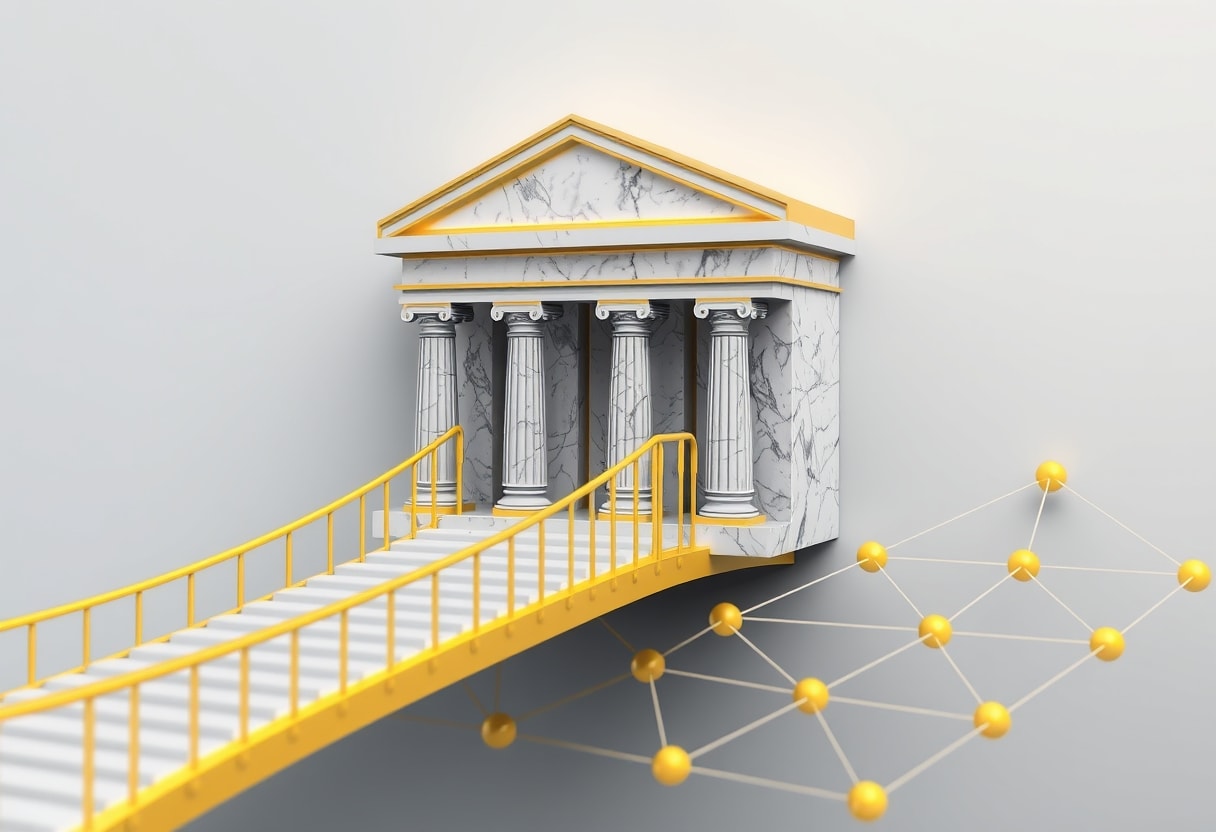
Legacy finance is being reconfigured into a highly efficient digital asset landscape.
🔗 The palpable shift wasn't just in the jargon; it was in the room itself. Gone were many of the starry-eyed startup founders; in their place, central bank officials, seasoned asset managers, and C-suite executives from firms with billions under management. The debate wasn't about if blockchain has a place in finance, but how fast they can scale it. Translation: the initial risk has been de-risked, and now the harvest is beginning.
📌 Tokenization: From Speculative Dream to Institutional Plumbing
💧 The panels, overtly titled things like “Is Tokenization the Future?”, served as a grand unveiling of what we’ve long suspected: assets once considered the epitome of illiquidity—bonds, equities, vast funds, and tangible real estate—are quietly being digitized and put on-chain. This isn't about revolutionary new assets; it's about making old assets more efficient for the players who already own them.
🏛️ Industry titans from Coinbase and Ripple, sharing a stage with officials from the European Central Bank, painted tokenization as the holy grail for reducing painful settlement times, boosting liquidity for previously locked-up capital, and enabling fractional ownership. Notice the nuance: it's not "rebuilding the financial system from scratch" anymore. It's about bolting on efficiency modules without disrupting the established order. This is classic institutional strategy: embrace innovation only when it serves their existing model, not when it threatens it.
The proof, as they say, is in the pudding. Firms like BlackRock, BNY Mellon, and Euroclear confirmed they are well past pilot programs. They are actively deploying tokenized instruments at a scale that demands attention. The data echoed this, with the Total Value Locked (TVL) in tokenized RWAs surpassing that $22 billion mark, fueled by broader asset coverage and growing, strategic institutional participation. And in a development that continues to reinforce its foundational role, Ethereum still underpins over 65% of these tokenized assets, solidifying its position as the preferred settlement layer for these new, old-money constructs.
The $22B RWA surge marks a definitive shift in global blockchain utility.
📌 Regulation and Stablecoins: The Gatekeepers of Capital
📜 The elephant in every room, especially in crypto, is regulation. And in Davos, it was repeatedly lauded as the absolute catalyst for this institutional momentum. The clarity provided by frameworks finalized in 2025 across the US and parts of Europe wasn't just a convenience; it was the green light the banks and custodians needed. They now have definitive rules for issuance, custody, and, crucially, compliance. No more gray areas, no more legal ambiguity – just a clear path to deployment.
Adding gravitas, US President Donald Trump himself underscored this direction, specifically highlighting the GENIUS Act, which laid down a federal framework for payment stablecoins. These stablecoins, often dismissed by maximalists as centralized relics, were now being hailed as the "plumbing" connecting traditional finance, decentralized finance, and the burgeoning tokenized asset class. They aren't trying to displace banks; they are enabling banks to move faster for settlement, treasury operations, and cross-border transfers. It's a pragmatic, rather than revolutionary, application.
📌 ⚖️ Stakeholder Analysis & Historical Parallel
To truly understand the implications of Davos 2026, we must look back. The most analogous event in recent crypto history isn't a regulatory crackdown, but a period of unbridled, unregulated expansion followed by a brutal contraction: the 2017-2018 Initial Coin Offering (ICO) boom and bust. In 2017, billions flowed into nascent projects, many with little more than a whitepaper and a promise. Retail investors, fueled by FOMO, piled in. The outcome? A spectacular market crash in 2018, exposing rampant fraud, unsustainable business models, and leaving a trail of decimated retail portfolios.
The lesson learned was stark: without regulatory clarity, institutional capital largely stays on the sidelines. While retail got burned experimenting with a truly "open" and "permissionless" future, big finance watched, studied, and waited. That chaotic period was the proving ground, the beta test paid for by millions of small investors.
In my view, this current wave of institutional tokenization, backed by 2025's regulatory frameworks and the GENIUS Act, isn't a sudden embrace of crypto's spirit; it's a calculated, patient entry. It appears to be a deliberate move by 'big players' to move in once the regulatory hurdles are cleared and the underlying technology has proven its resilience (and its profitability potential). This time, the difference is profound: they aren't speculating on untested protocols. They are leveraging a now-established, regulated infrastructure (Ethereum, stablecoins) to make their existing multi-trillion-dollar asset classes more efficient for themselves. The chaos of 2017-2018 taught them to let the retail market bear the initial risk of discovery and price volatility before they step in to "professionalize" the landscape.
Financial entities are now integrating ETH as the core settlement layer.
Stakeholder
Position/Key Detail
Central Bank Officials
⚡ View tokenization as critical infrastructure; focused on scaling and operational efficiency.
Large Asset Managers (BlackRock, BNY Mellon, Euroclear)
Actively deploying tokenized instruments at scale, moving beyond pilot projects.
Coinbase & Ripple Executives
Advocate tokenization for reduced settlement times, improved liquidity, and fractional ownership.
US President Donald Trump
Reinforced regulatory direction; highlighted GENIUS Act for payment stablecoin framework.
Consulting Firms (McKinsey, Boston Consulting Group)
Estimate tokenized assets to reach $2T-$16T by 2030, signaling massive future growth.
📌 🔑 Key Takeaways
The narrative for crypto has decisively shifted from retail speculation to institutional utility, with RWA tokenization leading the charge.
Regulatory clarity (2025 frameworks, GENIUS Act) has unlocked significant institutional capital, allowing firms like BlackRock to scale tokenized assets.
Ethereum remains the dominant settlement layer for tokenized RWAs, hosting over 65% of the $22 billion+ market value.
Stablecoins are being embraced as crucial "plumbing" for inter-ecosystem value transfer, enabling banks rather than competing with them.
Investors should prepare for a less speculative, more structurally driven crypto market, where utility and integration with traditional finance dictate value.
🔮 Thoughts & Predictions
The current market dynamics, particularly the institutional embrace of RWA tokenization highlighted at Davos 2026, strongly echo the post-ICO bust recovery where regulated entities began to circle. While the 2017-2018 period saw retail bear the brunt of speculative failures, today's landscape is one where institutional players are strategically moving to capture the efficiency gains and new revenue streams offered by a now-regulated blockchain space. This isn't altruism; it's a shrewd expansion of their existing power structures.
From my perspective, the key factor is not just the $22 billion in tokenized assets, but the projected growth to $2 trillion to $16 trillion by 2030. This indicates a medium-term shift where value accrual might increasingly favor the underlying infrastructure providers (like Ethereum) and those traditional entities that successfully integrate tokenization, potentially at the expense of highly speculative, non-utility driven altcoins. The initial euphoria and decentralization maximalism are giving way to a more pragmatic, centralized integration. Expect the largest beneficiaries to be those enabling this shift, not necessarily the most 'disruptive' in the traditional crypto sense.
It's becoming increasingly clear that the "institutional siphon" is well underway, allowing these giants to tap into a more liquid, faster settlement layer for their vast, existing asset base. The real long-term impact for investors will be a re-evaluation of what constitutes "value" in crypto—shifting from pure speculative narrative to verifiable utility within a regulated financial ecosystem. This is not the wild west; it's the fortified bank vault, now with a blockchain interface.
📌 Future Outlook: The Long Game of Institutional Capture
The vision emerging from Davos 2026 paints a future where the crypto market is less of an isolated, speculative playground and more an integrated, indispensable component of global finance. The regulatory environment will only grow more stringent and globally coordinated. This isn't just about preventing fraud; it's about channeling vast pools of capital into compliant, controllable rails.
⚖️ For investors, this shift presents both opportunities and risks. The opportunity lies in identifying projects and assets that truly facilitate this institutional adoption—those providing robust, secure infrastructure (like Ethereum), compliant stablecoins, and specialized platforms for RWA tokenization. Less speculative gains, perhaps, but potentially more stable, utility-driven growth. The risk, however, is that as institutional capital floods in, it could dilute the value propositions of purely speculative assets, or worse, marginalize those projects that fail to align with the new regulatory realities. The 'big players' are not just entering the game; they're rewriting the rules.
Global liquidity flows are moving toward transparent on-chain tokenized asset structures.
🎯 Investor Action Tips
Focus on Infrastructure: Prioritize investments in foundational layers (e.g., Ethereum, Solana, Avalanche) and secure stablecoin providers that underpin institutional RWA tokenization.
Evaluate Utility Over Hype: Shift portfolio allocation towards projects demonstrating clear, compliant utility for enterprise and financial institutions, moving away from purely speculative, meme-driven assets.
Monitor Regulatory Alignment: Track developments in US (GENIUS Act) and EU regulatory frameworks; projects that adapt and integrate these guidelines will have a distinct competitive advantage.
Diversify within Tokenization: Research and consider exposure to specific RWA tokenization platforms or projects specializing in particular asset classes (e.g., real estate, private credit) that are attracting institutional capital.
📘 Glossary for Serious Investors
Tokenization: The process of converting rights to an asset into a digital token on a blockchain, enabling fractional ownership, improved liquidity, and faster settlement.
Real-World Assets (RWAs): Tangible and intangible assets existing outside the blockchain (e.g., real estate, bonds, commodities) that are represented as tokens on a blockchain.
Stablecoins: Cryptocurrencies designed to minimize price volatility, typically pegged to a fiat currency (like USD) or a basket of assets, acting as a crucial bridge between traditional finance and crypto.
Total Value Locked (TVL): A metric representing the aggregated value of assets staked or locked in a decentralized finance (DeFi) protocol or, in this context, within tokenized RWA platforms, indicating market adoption and liquidity.
🧭 Context of the Day
Today, the RWA tokenization narrative at Davos solidifies that institutional finance is now actively harnessing blockchain for its own operational gains, reshaping crypto's future into a more integrated, regulated ecosystem.
💬 Investment Wisdom
"Innovation starts as a speculative toy and ends as the invisible plumbing of the world." — Marc Andreessen
Digital asset forecast analyzing upcoming volatility: crypto market, next bull run, BTC price. Bitcoin's "Moonvember" Hopes Tempered by Market Realities: A Deep Dive for Investors 📌 Navigating Bitcoin's November Crossroads: Will History Repeat? The cryptocurrency market is at a fascinating juncture as we enter November 2025. Bitcoin, fresh off a somewhat disappointing "Uptober" where it retraced over 10% after briefly touching $126,000 , faces a pivotal month. Historically, November, often referred to as "Moonvember," has been a strong period for Bitcoin. But can historical trends overcome current market headwinds? To understand the present, it's essential to acknowledge the past. Bitcoin's price action has often followed predictable seasonal patterns. October and November, in particular, have been associated with bullish...
Tokenization boom accelerates: XRP ecosystem integrates $50T property. RWA crypto, digital assets, blockchain real estate. Epic Chain's XRP Integration: A Trillion-Dollar RWA Opportunity? 🔗 Epic Chain, a project supported by Ripple, is making significant strides in the tokenization of real-world assets (RWAs) by leveraging the XRP Ledger. This initiative aims to bring trillions of dollars worth of assets onto the blockchain, potentially revolutionizing how real estate, credit, commodities, and collectibles are managed and traded. But what does this mean for crypto investors? 📌 Ripple's Backing and Epic Chain's RWA Platform Epic Chain is positioning itself at the forefront of the RWA tokenization movement with its XRP-native platform. The platform is designed to facilitate the transfer of real estate, credit, commodities, and collectibles onto the XRP Ledg...
Introducing Solana's pivotal network upgrade, symbolizing growth and advancement. Solana's Alpenglow Upgrade: A Game-Changer for On-Chain Trading and Network Stability 🔗 Solana, a network long celebrated for its blistering speed and low transaction fees, has also navigated its share of stability challenges. As we move into 2025, a critical evolution is on the horizon: the Alpenglow consensus overhaul . This isn't just another incremental update; it's a fundamental reimagining of Solana's core architecture, poised to address longstanding concerns regarding validator performance, network stability, and long-term scalability. For investors, understanding this seismic shift is paramount, as it could significantly redefine SOL's competitive edge and its role within the broader blockchain ecosystem . 📌 🚀 The Alpenglow Evolution: Diving ...