Stay updated with the latest in cryptocurrency and blockchain news, delivered fast and reliably. Bookmark this page and check back often for valuable insights and timely information!
Initial BTC network adjustments reveal a fleeting window of operational relief for struggling miners. The Illusion of Ease: Why Bitcoin's Latest Difficulty Dip is No Panacea for Miners In early January 2026, the Bitcoin network delivered what seemed, on the surface, like a welcome reprieve: its first difficulty recalibration of the new year saw the metric slip to just over 146 trillion . From a purely technical standpoint, this slight easing was a direct result of average block times briefly running faster than the targeted 10 minutes, clocking in at around 9.88 minutes . For those unfamiliar with the minutiae, a faster block production rate signals to the protocol that mining is getting "too easy," thus prompting a downward adjustment in difficulty to restore equilibrium. However, as any grizzled veteran of this market knows, appearances can ...
Get link
Facebook
X
Pinterest
Email
Other Apps
XRP ETFs Ignite Supply Squeeze Fears: 750M Coins Removed From Exchanges - What This Means for XRP's Market
Get link
Facebook
X
Pinterest
Email
Other Apps
-
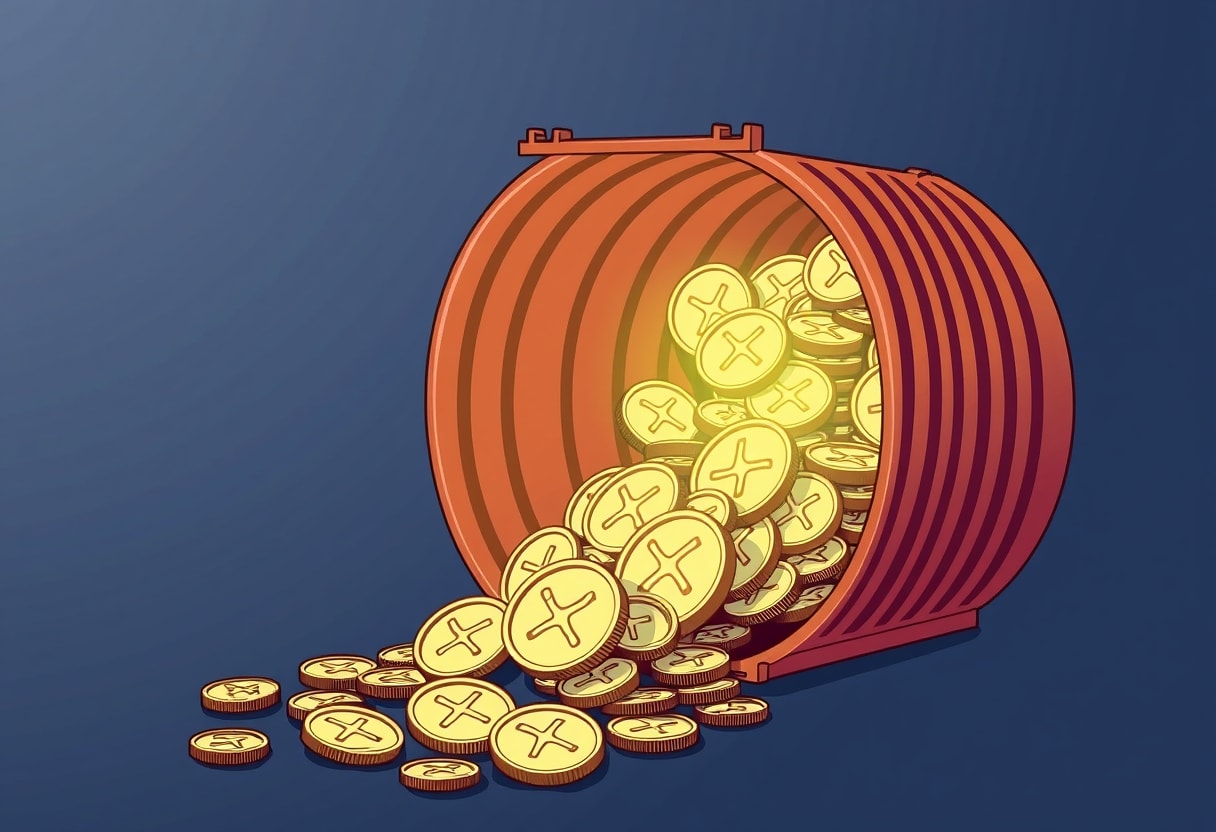
Safeguarding XRP as exchange reserves dwindle.
📌 XRP ETFs Spark Historic Supply Squeeze: A Structural Shift Reshaping the Market for Investors
In the evolving landscape of digital assets, 2025 is proving to be a watershed year for XRP, primarily driven by the accelerating influence of institutional capital through Exchange-Traded Funds (ETFs). What we’re witnessing now is a critical phase where XRP’s market structure is beginning to dictate sentiment, rather than the other way around. Analysts are increasingly focused on whether the sustained absorption by these institutional vehicles will act as a long-term demand sink, profoundly tightening liquid supply and fundamentally altering the mechanisms of price discovery for the asset.
XRP Price TrendLast 7 Days
Powered by CryptoCompare
This isn't just about big players buying; it's about a systemic reallocation of XRP from accessible trading pools to long-term institutional vaults. For crypto investors, this structural transformation carries significant implications, promising both potential opportunities and novel risks that demand close attention.
The Institutional Tide for XRP: Understanding the Supply Contraction
Event Background and Significance: The Rise of Institutional XRP
⚖️ The journey of XRP has been tumultuous, marked by a prolonged regulatory battle with the U.S. Securities and Exchange Commission (SEC) that cast a long shadow over its institutional adoption. Historically, this legal uncertainty prevented mainstream financial products from embracing XRP, despite its technological prowess and potential for cross-border payments. The turning point arrived with greater regulatory clarity, spurred by legislative efforts like the (hypothetical, but implied by the article) Clarity Act, which paved the way for compliant institutional participation. This clarity, along with Ripple's partial legal victories, fundamentally de-risked XRP for traditional finance.
🚀 Fast forward to 2025, and we're seeing the direct consequence: the launch and rapid growth of XRP ETFs. These products, similar to Bitcoin and Ethereum ETFs that preceded them, offer traditional investors regulated, accessible exposure to XRP without the complexities of direct custody. This newfound access has unleashed a torrent of institutional demand, setting the stage for what many are now calling a supply squeeze.
Shrinking Supply: Evidence from the Exchanges
Recent on-chain data and market observations highlight a dramatic and sustained decline in XRP balances held across centralized exchanges. A prominent market commentator on X (formerly Twitter) brought this to the forefront, pointing out a significant structural shift in how XRP is being absorbed and held. Specifically, XRP ETFs have reportedly removed approximately 750 million XRP from exchanges within a mere few weeks. This pace is staggering, leaving an estimated 1.5 billion XRP in liquid exchange reserves, a figure that continues to trend downward.
⚖️ This visible contraction in exchange-held supply is particularly telling because it's occurring while XRP's price action remains relatively stable. This stability, in the face of dwindling liquidity, suggests a deliberate, conviction-driven absorption rather than speculative buying. It's a clear indicator of long-term institutional positioning, where large blocks of XRP are being moved off exchanges and into secure, ETF-linked custody structures, effectively sidelining them from daily trading activity.
Depleting exchange balances as ETF demand surges.
Market Impact Analysis: The Mechanics of a Supply Shock
Short-Term & Long-Term Effects
💧 The immediate impact of this supply contraction is a reduction in market liquidity. With less XRP available for trading on exchanges, even moderate buying pressure can have a more pronounced effect on price. In the short term, this could lead to increased price volatility, as lower liquidity tends to amplify price movements.
However, the long-term effects are potentially more profound. ETF-held XRP functions as locked capital. Once absorbed into these institutional products, tokens are typically not available for short-term speculation. This creates a largely one-directional supply dynamic, where XRP is being withdrawn from the open market with limited returns. This consistent outflow, sustained through both price peaks and pullbacks, lays the groundwork for a structural supply shock.
💧 Should this trend persist, the market could enter a low-float environment where marginal demand exerts disproportionate influence on price. Price formation would shift away from speculative churn and toward liquidity mechanics, with availability and institutional flows becoming paramount. This scenario could dramatically alter investor sentiment, transitioning from a focus on news cycles to the fundamental supply-demand dynamics driven by institutional participation.
💱 For retail investors, this evolving landscape presents both opportunities and risks. The opportunity lies in potential price appreciation as scarcity drives up value. However, risks include increased volatility and potentially higher slippage on trades due to reduced liquidity. Understanding the positions of these stakeholders is crucial. Institutional buyers are driven by long-term strategic positioning, seeking to capitalize on XRP's utility and established network, which is a fundamentally different dynamic from short-term retail speculation.
Future Outlook: The Road to 2026 and Beyond
💱 The analysis suggests that early 2026 is emerging as a critical structural inflection point for XRP. This projection isn't based on an aggressive acceleration of absorption, but rather on the simple continuation of current trends. At the present rate of ETF-driven absorption, exchange balances could approach critically thin levels. This means that the remaining liquid supply will increasingly define price discovery.
Tracking institutional inflows into XRP ETFs.
In such a low-float market, price formation becomes highly sensitive to even minor shifts in demand, as there's less available supply to buffer large orders. This environment could lead to sharp, upward price movements, driven purely by the mechanics of supply and demand, rather than hype or news. The regulatory clarity provided by the Clarity Act ensures that institutions can confidently hold XRP for the long haul, reducing the likelihood of these tokens returning to the open market any time soon.
💧 This tightening market indicates that XRP's next major phase will be fundamentally shaped by scarcity and institutional liquidity dynamics. Investors should prepare for a market where traditional valuation metrics might be superseded by the sheer force of supply-demand imbalances, a scenario highly favorable for long-term holders if this trend continues unabated.
📌 🔑 Key Takeaways
Institutional Absorption Dominates: XRP ETFs have rapidly removed 750 million coins from exchanges, signifying a major shift towards institutional holding and away from speculative liquidity.
Supply Squeeze Imminent: At current rates, exchange-held XRP could hit critically low levels by early 2026, leading to potential supply shock and increased price volatility.
Regulatory Clarity is Key: Legislative frameworks like the Clarity Act have de-risked XRP, making it suitable for long-term institutional balance sheet exposure and driving current trends.
Structural Price Discovery: Future price movements are likely to be dictated more by liquidity mechanics and institutional flows than by retail sentiment, rewarding long-term conviction.
🔮 Thoughts & Predictions
The current market dynamics for XRP are moving beyond mere sentiment. We are witnessing a fundamental, structural transformation driven by institutional demand that cannot be overstated. The consistent reduction of liquid XRP supply on exchanges signals a powerful, long-term play by sophisticated investors positioning for scarcity-driven price appreciation. This isn't just another bullish narrative; it's a data-backed shift in how XRP's value will be realized.
From my perspective, the key factor moving forward is the inelasticity of supply versus growing institutional appetite. By early 2026, if this rate of ETF absorption persists, we could see exchange balances fall below the 1 billion XRP mark, a level where even moderate buying could trigger exponential price movements. This implies a potential medium-term price trajectory that could surprise even seasoned XRP holders, with the asset becoming significantly more volatile on the upside. The 'Clarity Act' mentioned further cements institutional confidence, making these positions sticky rather than transient.
This structural tightening also has implications for market behavior: expect less influence from daily news cycles and more from large block trades and the sheer unavailability of sell-side liquidity. The market is teaching us that compliant institutional access can transform an asset's fundamental supply-demand equation, potentially setting XRP on a path to new all-time highs driven by genuine scarcity. Prepare for a future where simply holding XRP off-exchange becomes a powerful market signal.
Anticipating the market's reaction to reduced liquidity.
🎯 Investor Action Tips
Monitor Exchange Balances: Keep a close eye on XRP balances on centralized exchanges. A continued downward trend reinforces the supply squeeze narrative, indicating potential for higher volatility.
Evaluate Long-Term Holdings: Consider the implications of reduced liquidity for your investment strategy. For long-term holders, this structural shift might reduce the temptation for short-term trading.
Understand Slippage Risk: If you are a short-term trader or plan large trades, be aware that reduced liquidity due to the supply squeeze could lead to higher price slippage.
Research Institutional Flow: Stay informed about new XRP ETF launches and institutional adoption metrics, as these are increasingly the primary drivers of market dynamics.
📘 Glossary for Serious Investors
⚖️ Supply Squeeze: A market condition where the available supply of an asset is unable to meet demand, leading to rapid price increases as buyers compete for scarce units.
⚖️ Price Discovery: The process by which the market determines the fair value of an asset, typically influenced by factors like supply, demand, and trading activity.
⚖️ Clarity Act: (Hypothetical in this context) A legislative framework that provides regulatory certainty for digital assets, enabling compliant institutional participation and investment.
🧭 Context of the Day
XRP's institutional absorption via ETFs is rapidly reconfiguring its market, indicating a structural shift where scarcity, not sentiment, will drive its future price discovery.
📈 RIPPLE Market TrendLast 7 Days
Date
Price (USD)
7D Change
12/23/2025
$1.90
+0.00%
12/24/2025
$1.87
-1.52%
12/25/2025
$1.86
-2.11%
12/26/2025
$1.83
-3.71%
12/27/2025
$1.84
-3.12%
12/28/2025
$1.87
-1.52%
12/29/2025
$1.86
-1.98%
12/30/2025
$1.85
-2.71%
Data provided by CoinGecko Integration.
💬 Investment Wisdom
"The biggest risk is not taking any risk... In a world that is changing really quickly, the only strategy that is guaranteed to fail is not taking risks." — Mark Zuckerberg
Digital asset forecast analyzing upcoming volatility: crypto market, next bull run, BTC price. Bitcoin's "Moonvember" Hopes Tempered by Market Realities: A Deep Dive for Investors 📌 Navigating Bitcoin's November Crossroads: Will History Repeat? The cryptocurrency market is at a fascinating juncture as we enter November 2025. Bitcoin, fresh off a somewhat disappointing "Uptober" where it retraced over 10% after briefly touching $126,000 , faces a pivotal month. Historically, November, often referred to as "Moonvember," has been a strong period for Bitcoin. But can historical trends overcome current market headwinds? To understand the present, it's essential to acknowledge the past. Bitcoin's price action has often followed predictable seasonal patterns. October and November, in particular, have been associated with bullish...
Tokenization boom accelerates: XRP ecosystem integrates $50T property. RWA crypto, digital assets, blockchain real estate. Epic Chain's XRP Integration: A Trillion-Dollar RWA Opportunity? 🔗 Epic Chain, a project supported by Ripple, is making significant strides in the tokenization of real-world assets (RWAs) by leveraging the XRP Ledger. This initiative aims to bring trillions of dollars worth of assets onto the blockchain, potentially revolutionizing how real estate, credit, commodities, and collectibles are managed and traded. But what does this mean for crypto investors? 📌 Ripple's Backing and Epic Chain's RWA Platform Epic Chain is positioning itself at the forefront of the RWA tokenization movement with its XRP-native platform. The platform is designed to facilitate the transfer of real estate, credit, commodities, and collectibles onto the XRP Ledg...
Introducing Solana's pivotal network upgrade, symbolizing growth and advancement. Solana's Alpenglow Upgrade: A Game-Changer for On-Chain Trading and Network Stability 🔗 Solana, a network long celebrated for its blistering speed and low transaction fees, has also navigated its share of stability challenges. As we move into 2025, a critical evolution is on the horizon: the Alpenglow consensus overhaul . This isn't just another incremental update; it's a fundamental reimagining of Solana's core architecture, poised to address longstanding concerns regarding validator performance, network stability, and long-term scalability. For investors, understanding this seismic shift is paramount, as it could significantly redefine SOL's competitive edge and its role within the broader blockchain ecosystem . 📌 🚀 The Alpenglow Evolution: Diving ...