Stay updated with the latest in cryptocurrency and blockchain news, delivered fast and reliably. Bookmark this page and check back often for valuable insights and timely information!
Unlocking the strategic potential of XRP as a primary liquidity tool for global finance. XRP is trading near $1.39 today, with some analysts calling it "Bitcoin at $200 in its early days." This sounds compelling, but the market tends to forget a fundamental lesson: the pathways to institutional adoption are rarely as direct as retail speculation. Let's look at what's actually happening, not just what's being speculated. XRP Price Trend Last 7 Days Powered by CryptoCompare 📍 Beyond the Hype Deconstructing XRPs Institutional Narrative For years, XRP has navigated a turbulent market, marked by extreme volatility and profound regulatory uncertainty. After its 2017 peak, the tok...
Get link
Facebook
X
Pinterest
Email
Other Apps
Ethereum Price Holds Support Levels: Analysts Warn of Critical Zones Below $2,000 Mark
Get link
Facebook
X
Pinterest
Email
Other Apps
-
Holding critical support levels as the market watches.
Ethereum's Precipice: On-Chain Data Warns of Critical Zones Below $2,000 as 2026 Approaches
📌 The Ethereum Outlook: A Fraught Close to 2025
🚀 As 2025 draws to a close, the crypto market is bracing for what could be a turbulent start to the new year, with Ethereum (ETH) finding itself at a critical juncture. After what has been a challenging year, culminating in a double-digit loss, attention is now firmly fixed on key on-chain metrics that analysts believe could dictate ETH's price trajectory in the coming months. The market's second-largest cryptocurrency, a cornerstone of the DeFi and NFT ecosystems, is currently down over 40% from its all-time high of $4,946, trading around the $2,940 mark.
ETH Price TrendLast 7 Days
Powered by CryptoCompare
🔗 This period of sustained weakness reflects broader market struggles and a noticeable shift in investor sentiment. The stakes are particularly high because Ethereum's price stability impacts not just ETH holders, but also the myriad decentralized applications and projects built upon its blockchain. Understanding these underlying pressures, especially from an on-chain perspective, is paramount for any serious crypto investor navigating the complex waters of late 2025 and early 2026.
📌 Event Background: The On-Chain Alarms Ringing for ETH
🔗 The current concerns aren't baseless speculation but rather stem from detailed analysis of Ethereum's underlying blockchain data. Historically, on-chain metrics have proven to be powerful indicators of market sentiment and potential price movements, often providing a clearer picture than purely technical chart analysis. In market cycles past, a confluence of bearish on-chain signals has frequently preceded significant price corrections, underscoring the importance of vigilance now.
A recent warning from Alphractal CEO and founder Joao Wedson, a prominent on-chain analyst, has brought these concerns into sharp focus. Wedson's analysis highlights three interconnected on-chain support levels that ETH is currently clinging to. A failure at these points, he suggests, could trigger an "aggressive downside move," potentially pushing the Ethereum price below the psychologically significant $2,000 mark once more. This isn't just about a simple price dip; it speaks to fundamental shifts in capital inflow and investor conviction.
Three Pillars of Support: Unpacking Wedson's Analysis
Joao Wedson's comprehensive analysis points to specific on-chain indicators as critical support zones:
1. MVRV Z-Score: The Final Cushion
🐻 The MVRV (Market Value to Realized Value) Z-Score is a crucial metric that helps identify when an asset is overvalued or undervalued relative to its "fair value." It compares market cap to realized cap, adjusted by standard deviation. Wedson notes that Ethereum's MVRV Z-Score is currently resting precisely on its "final support cushion." A breach of this level would historically indicate that the asset is becoming significantly undervalued, but in a bear market, it can also precede further downside as capitulation accelerates. For investors, this signals extreme fragility, where the market is either on the brink of a major bounce or a full-blown capitulation.
Analyzing intricate on-chain data for market sentiment.
💰 2. Market Cap Growth Rate: Weakening Inflows
💰 The Market Cap Growth Rate provides insight into the real expansion of Ethereum's market capitalization over time, reflecting whether new capital is flowing into the ecosystem or stagnating. Wedson states this metric is testing a "critical structural support level." A drop below this could indicate "weakening capital inflows," suggesting that new investment is drying up and potentially signaling sustained downside pressure. This is a direct measure of market enthusiasm and liquidity, and its decline points to a lack of fresh demand to absorb selling pressure.
💰 The Delta Growth Rate measures the divergence between Realized Cap growth and Market Cap growth, often generating an "on-chain alpha signal." According to Wedson, this metric is also at a critical support level. A loss here would "suggest speculative capital exiting the market," significantly increasing the likelihood of a "future capitulation phase." This indicator effectively gauges whether long-term holders are accumulating or if short-term, speculative money is bailing out, a key sign of market health and conviction.
📌 Market Impact Analysis: Navigating the Headwinds
Should these critical on-chain foundations break, the immediate market impact for Ethereum could be severe. Wedson predicts a "huge likelihood" of ETH falling below the $2,000 mark, with a potential "over 30% correction" from current price points. This scenario would be driven by increasing supply pressure against declining demand as the market heads into 2026.
In the short-term, investors should prepare for heightened price volatility. A break of these supports would likely trigger a wave of selling, driven by both algorithmic trading and panic from retail investors. This could lead to cascade liquidations in the derivatives market, further exacerbating price declines. Sentiment, already fragile, could shift decisively bearish, making a recovery difficult in the immediate aftermath.
A trader observing key support zones for ETH price.
⚖️ Medium to long-term implications are also significant. A sustained period below $2,000 could damage investor confidence in the broader crypto market, potentially impacting growth across the DeFi, NFT, and Layer-2 sectors that heavily rely on Ethereum's ecosystem. Projects built on Ethereum might find it harder to attract new capital or maintain user engagement if the underlying asset shows prolonged weakness. However, for long-term holders and strategic investors, such a significant correction could also present a generational buying opportunity, assuming Ethereum's fundamental value proposition remains intact.
📌 Key Stakeholders’ Positions: Caution and Calculated Risk
The primary stakeholder in this analysis is Alphractal CEO Joao Wedson himself, representing the on-chain analytics community. His position is one of measured caution, emphasizing the significant downside risk based on the confluence of critical metric failures. He doesn't, however, entirely dismiss the idea of taking a long position for investors with a "higher risk appetite," even at current levels, acknowledging the potential for a rebound if these supports unexpectedly hold or if macro conditions improve. This highlights the inherent duality of crypto investing: significant risk often accompanies significant potential reward.
The general investor sentiment, as implied by Wedson's "fragile position from a broader outlook," suggests widespread apprehension. Large institutional players are likely monitoring these on-chain metrics closely, while retail investors may be swayed by market headlines and price action, leading to reactive decisions. The lack of strong capital inflows points to institutional hesitancy, a critical factor for market momentum.
📌 Future Outlook: Navigating the Crossroads
The path forward for Ethereum is bifurcated. If the identified on-chain support levels hold, we could see a period of consolidation, potentially leading to a gradual recovery in early 2026. This would require renewed capital inflows and a shift in investor sentiment, perhaps triggered by positive regulatory news or a broader macroeconomic turnaround.
However, if these supports fail, the market must prepare for a deeper correction and a potential "capitulation phase." This could push ETH well below $2,000, testing even lower support zones not identified in the immediate analysis. Such a scenario, while painful in the short term, could ultimately cleanse the market of speculative froth, setting the stage for a more sustainable recovery fueled by genuine innovation and adoption rather than pure speculation. Investors should closely monitor capital inflow metrics and the aggregate behavior of long-term holders.
Stakeholder
Position/Key Detail
Joao Wedson (Alphractal CEO)
⚡ Warns of 3 critical on-chain support levels; failure could lead to ETH below $2,000, 30%+ correction.
👥 Ethereum Investors
Facing "fragile position" and potential for aggressive downside; high-risk appetite traders considering long positions.
MVRV Z-Score
ETH on "final support cushion"; failure suggests aggressive downside.
💰 Market Cap Growth Rate
⚡ Testing "critical structural support"; break indicates weakening capital inflows.
Delta Growth Rate
Also at support; loss suggests speculative capital exiting, increasing capitulation risk.
📌 🔑 Key Takeaways
Ethereum is currently resting on three critical on-chain support levels (MVRV Z-Score, Market Cap Growth Rate, Delta Growth Rate) that could determine its price trajectory into 2026.
A break below these supports could see ETH fall below $2,000, with predictions of an "aggressive downside move" and a potential 30%+ correction.
Weakening capital inflows and speculative capital exiting the market are key signals of increasing supply pressure against declining demand.
While the immediate outlook is "fragile," a significant correction could present a long-term accumulation opportunity for high-risk investors, though caution is paramount.
🔮 Thoughts & Predictions
The confluence of three major on-chain support metrics converging at critical levels for Ethereum isn't just a technical blip; it's a profound signal of market anxiety as we transition from 2025 to 2026. From my perspective, the key factor here is the apparent erosion of speculative capital and a noticeable slowdown in new money entering the ETH ecosystem. This isn't merely about retail fear; it reflects a broader institutional hesitancy that often precedes significant price re-evaluations. If these on-chain supports give way, a drop below $2,000 isn't just possible, it becomes highly probable, paving the way for a deeper capitulation towards $1,800 or even $1,500 as leverage unwinds.
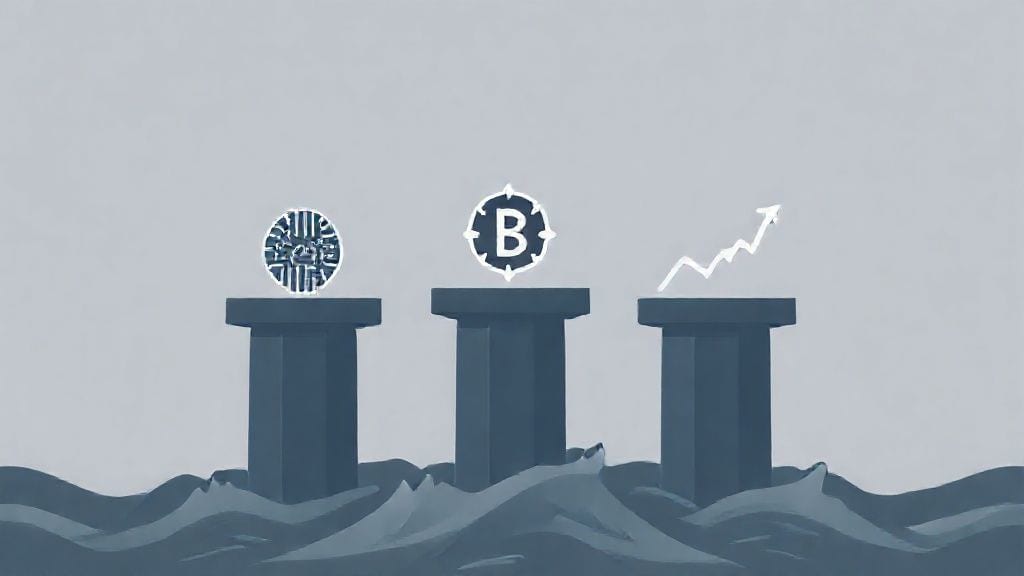
Identifying the three critical support zones for Ethereum.
However, this isn't necessarily a death knell. History shows that such "washout" phases are crucial for market health. The question isn't if Ethereum will rebound, but when and from what floor. I anticipate that a significant correction, perhaps triggered by further macro uncertainty in Q1 2026, would ultimately present one of the best accumulation opportunities in years for patient investors. The fundamental utility of Ethereum, especially with ongoing scaling solutions and potential regulatory clarity, remains immense.
Therefore, while the short-term forecast is undeniably bearish, offering a glimpse into what Wedson calls a "fragile position," smart money will be watching for signs of genuine demand returning once these on-chain indicators show signs of stabilization. The next 3-6 months will truly test the conviction of Ethereum holders, but also forge the foundation for its next bull cycle.
🎯 Investor Action Tips
Monitor On-Chain Metrics Closely: Pay specific attention to the MVRV Z-Score, Market Cap Growth Rate, and Delta Growth Rate for ETH. Tools like Glassnode or Santiment can provide real-time insights.
Prepare for Volatility: Consider hedging strategies or setting stop-loss orders below key support levels (e.g., $2,800, $2,500) if you are sensitive to downside risk.
Identify Accumulation Zones: If supports break and ETH dips below $2,000, begin researching potential accumulation zones (e.g., $1,800-$1,500) for a long-term buy strategy, focusing on dollar-cost averaging.
Re-evaluate Portfolio Allocation: Assess your current ETH exposure against your risk tolerance. Consider rebalancing or holding some stablecoins to capitalize on potential future dips.
📘 Glossary for Serious Investors
MVRV Z-Score: A valuation metric indicating whether an asset is over/undervalued by comparing its Market Value to its Realized Value, normalized by standard deviation.
Market Cap Growth Rate: A metric that tracks the rate at which an asset's total market capitalization is expanding, reflecting capital inflows into the asset.
Delta Growth Rate: Measures the divergence between an asset's Realized Cap growth and Market Cap growth, often signaling shifts in speculative vs. long-term investor behavior.
Capitulation Phase: A period of intense selling pressure in a market where investors, often in panic, sell their assets regardless of price, typically marking the end of a bear market.
🧭 Context of the Day
Ethereum's current on-chain fragility signals that investor conviction is undergoing a critical test, potentially shaping its trajectory well into 2026.
📈 ETHEREUM Market TrendLast 7 Days
Date
Price (USD)
7D Change
12/22/2025
$3,001.60
+0.00%
12/23/2025
$3,005.79
+0.14%
12/24/2025
$2,965.19
-1.21%
12/25/2025
$2,945.99
-1.85%
12/26/2025
$2,904.25
-3.24%
12/27/2025
$2,926.70
-2.50%
12/28/2025
$2,937.15
-2.15%
Data provided by CoinGecko Integration.
💬 Investment Wisdom
"The biggest risk is not taking any risk... In a world that is changing really quickly, the only strategy that is guaranteed to fail is not taking risks." — Mark Zuckerberg
Digital asset forecast analyzing upcoming volatility: crypto market, next bull run, BTC price. Bitcoin's "Moonvember" Hopes Tempered by Market Realities: A Deep Dive for Investors 📌 Navigating Bitcoin's November Crossroads: Will History Repeat? The cryptocurrency market is at a fascinating juncture as we enter November 2025. Bitcoin, fresh off a somewhat disappointing "Uptober" where it retraced over 10% after briefly touching $126,000 , faces a pivotal month. Historically, November, often referred to as "Moonvember," has been a strong period for Bitcoin. But can historical trends overcome current market headwinds? To understand the present, it's essential to acknowledge the past. Bitcoin's price action has often followed predictable seasonal patterns. October and November, in particular, have been associated with bullish...
Introducing Solana's pivotal network upgrade, symbolizing growth and advancement. Solana's Alpenglow Upgrade: A Game-Changer for On-Chain Trading and Network Stability 🔗 Solana, a network long celebrated for its blistering speed and low transaction fees, has also navigated its share of stability challenges. As we move into 2025, a critical evolution is on the horizon: the Alpenglow consensus overhaul . This isn't just another incremental update; it's a fundamental reimagining of Solana's core architecture, poised to address longstanding concerns regarding validator performance, network stability, and long-term scalability. For investors, understanding this seismic shift is paramount, as it could significantly redefine SOL's competitive edge and its role within the broader blockchain ecosystem . 📌 🚀 The Alpenglow Evolution: Diving ...
Tokenization boom accelerates: XRP ecosystem integrates $50T property. RWA crypto, digital assets, blockchain real estate. Epic Chain's XRP Integration: A Trillion-Dollar RWA Opportunity? 🔗 Epic Chain, a project supported by Ripple, is making significant strides in the tokenization of real-world assets (RWAs) by leveraging the XRP Ledger. This initiative aims to bring trillions of dollars worth of assets onto the blockchain, potentially revolutionizing how real estate, credit, commodities, and collectibles are managed and traded. But what does this mean for crypto investors? 📌 Ripple's Backing and Epic Chain's RWA Platform Epic Chain is positioning itself at the forefront of the RWA tokenization movement with its XRP-native platform. The platform is designed to facilitate the transfer of real estate, credit, commodities, and collectibles onto the XRP Ledg...